I dropped out of college after my first semester. During this time I worked at a boating supply store. Despite having a 3.5 average in summer school, I wasn’t passionate about any of my college classes. I lacked directional clarity as I coped with the realization I wasn’t going to be a professional baseball player. I was also concerned about misspending my TAP money. The New York State Tuition Assistance Program helps eligible New York residents pay tuition at approved schools in New York State. Depending on the academic year in which you begin study and it’s available for up to 8 semesters. In 2016, an annual TAP award can be up to $5,165 a year. Because TAP is a grant, it does not have to be paid back.
In January 1986, my financial aid advisor informed me I would receive a $5,800 check from the school. The refund was grant money allocated to the school for my spring tuition. I deposited the check and didn’t tell my mother, dropped out of school and continued living off campus. Within a month all the refund money was gone, $5,000 of it going toward a car. I paid for gas, insurance and rent by working at Defender. Defender sold boating supplies through a 50 page catalog nationwide.
Rafael worked 4 blocks away in a mall as a shoe salesman. The following semester, Rafael dropped out of college too. In the next two years my brother worked as a doorman, dishwasher/prep cook, car salesman and sold vacuum cleaners. As for me, I stopped working at Defender and spent most my days hanging out with friends. In time, I had to sell my car to pay for my living expenses. I returned to work in the spring of 1987 working for a financial printing firm located at 435 Hudson Street in Manhattan as night manager of the shipping department. I oversaw 3 messengers, sorted, packed and added postage on mail and was responsible of the petty cash box. Then came Black Monday. Black Monday refers to Monday, October 19, 1987, when stock markets around the world crashed, shedding a huge value in a very short time. The Dow Jones Industrial Average fell exactly 508 points to 1,738.74 (22.61%). Within four days, I was out of work.
In January 14th 1986, Pedro Borbon Jr. was drafted by the Los Angeles Dodgers in the 3rd round (January secondary draft), did not sign. Unlike me, Pedro didn’t grow up playing baseball. Pedro was discovered by Ben Wright, a security guard and junior varsity baseball coach at my High School in the fall of 1981. As Pedro entered the school Ben noticed Pedro’s name on his ID card and asked Pedro was he related to Pedro Borbon, the major league pitcher? Pedro replied “Yes, he’s my dad”, immediately Ben insisted Pedro Jr. tryout for the baseball team. Pedro made the junior varsity team and by midseason was on the varsity team. I was in awe of what he accomplished on the baseball field, but off the field, Pedro Jr. was 100 times more amazing.
In May 27, 1980, the Saint Louis Cardinals released Pedro Borbon Sr. and instead of returning home to the Dominican Republic, Pedro Sr. moved to Texas with another family he started in the Americas. This was very upsetting to Pedro Jr. and several months later he moved by himself to the United States at age 14 to live with his uncle (mother’s side) in the Bronx. Besides a place to stay, Pedro Jr’s uncle lacked the means to provide for his nephew. On several occasions, Pedro spent the night riding the trains on the New York City subways because he had nowhere to go when he stayed out past his 11pm curfew. Things I easily took for granted like my mother buying my school supplies and cloths, Pedro Jr. had to work to buy for himself. After high school, Pedro Jr. attended Ranger Junior College in Ranger, Texas with our mutual friend Randy Rivera.
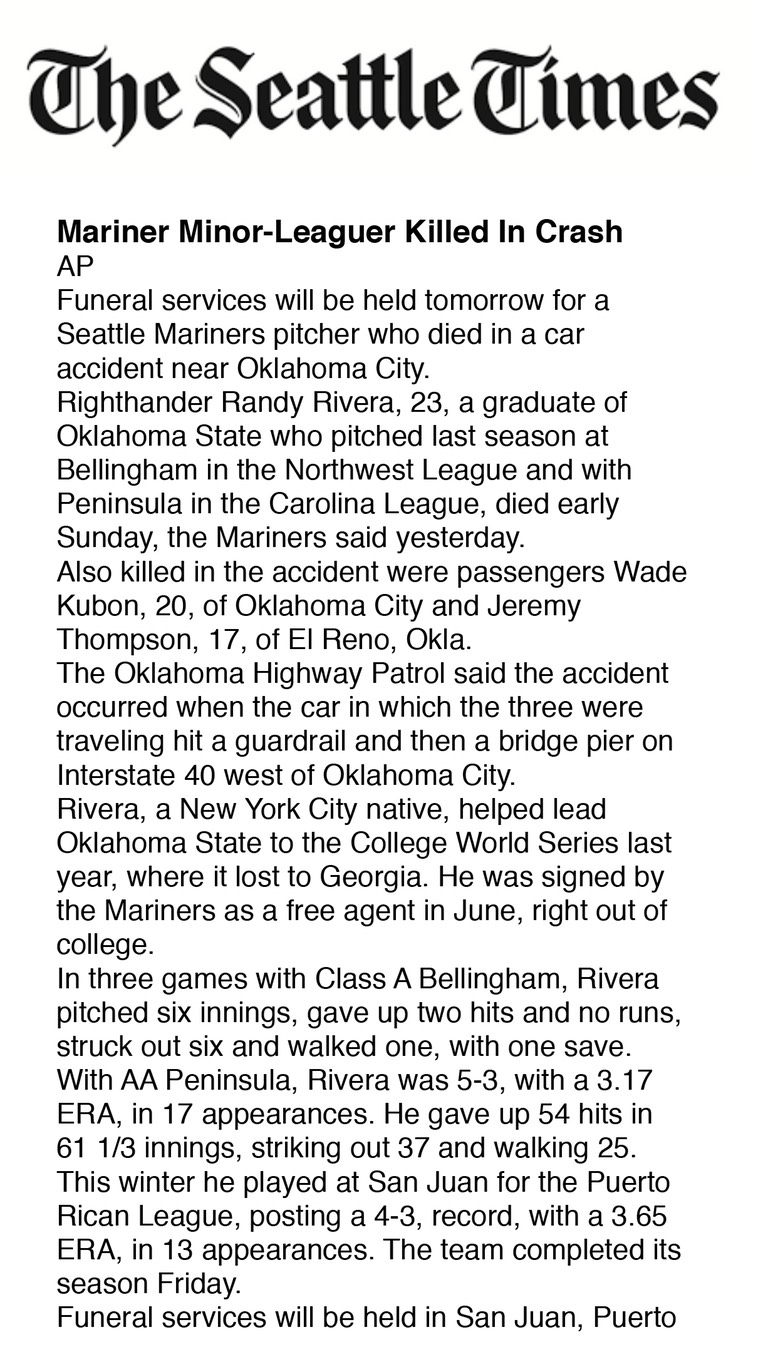
Randy grew up down the block from my grandmother’s apartment at 200 West 109th street with both his parents and two brothers. Outside of baseball, Randy followed his older brother’s career path as an aircraft mechanic in the U.S. Air Force. Unfortunately, Randy’s brother died in a motorcycle accident Randy’s junior year of high school. In 1987, after attending Ranger Junior College for 2 years, Randy was recruited to play baseball for the NCAA’s #1 ranked division one college baseball program, Oklahoma State University. Randy success was attributed to hard work and his ability to see himself succeed. He would call me from school and tell me he visualized himself playing in the big leagues. He’d get motivated when players he had success against made it to the majors. He’d say “ if the guys I’ve pitched well against made it to the big leagues, someone will notice me”.
On August 29 the Atlanta Braves signed Pedro Borbon Jr. and in the summer of 1990, the Seattle Mariners signed Randy Rivera. In the winter of 1989, I found out about Pedro Jr.’s signing when I picked Randy up at LaGuardia airport. I took Randy to 176th street and Grand Concourse, where his family moved to from Manhattan. I’d stay as a guest with him and his family for the entire time Randy was home. Despite being best friends, I can recall two occasions Randy got upset at me. The first involved Randy’s mother Mrs. Rivera, who loved to cook despite being diagnosed with Alzheimer’s disease. Alzheimer’s is a general term for memory loss and other intellectual abilities serious enough to interfere with daily life. Knowing this, I ate pancakes and eggs she just prepared for me and watched her make more food knowing everyone in the apartment had already eaten. Randy walked in as she was handing me a second plate and told his mother “you made him breakfast twice” as I giggled in the background. The other time was in February 1990, all day Randy seemed upset and told me he needed to talk to me about something serious. By now, Mrs. Rivera Alzheimer’s required 24 hour supervision and lived the past 13 months in an assisted care facility. While in his home, Randy showed me pictures he found in his dad’s jacket of another woman wearing lingerie as he held back tears and voiced his displeasure. Instead of being sensitive to my friend’s feelings, I greeted him with a high five gesture and gazed at the photos with admiration. I said to Randy, “She’s hot! Your Dad’s the man!” Now even more upset, he called me a fool and didn’t speak to me for the next couple of hours. I apologized and stopped asking him if I could keep the photos. After dropping Randy off at Newark Airport and saying goodbye, I returned home with all my stuff. Once home, I was no longer my mother’s favorite son. This honor belonged to Rafael since he returned to school to study accounting. He was influenced by his previous roommates, one roommate was a lawyer (working) and the other an accountant who was also his landlord. One evening as my brother and his roommates watched TV, my brother told his roommates how lucky they were to have careers and not jobs like him. They quickly told my brother he could do the same if he just gets out of his own way. His roommates candor addressed all Rafael’s objections in three minutes. Rafael asked, “ how am I going to pay for my car” They answered, “sell the car” Rafael replied, “ how am I going to get to my new job selling carpets?’ They replied, “quit your job”. My brother laughed and asked, “ how am I going to pay the rent?” The accountant replied, “move back home with your mother”. Back in school and with our mother, Rafael had a perfect 4.0 g.p.a. his first semester while taking 21 credits (7 classes) He was able to do this by micromanaging his time. He avoided all people and distractions not inline with his school work, most notably me. He didn’t have time for nonsense and had nothing in common with my lifestyle and the company I kept. I looked for shortcuts or angles to avoid work. I had a false sense of entitlement and found myself attracted to like minded people. I tried to broker “society loans” type deals with people, similar to what my mom would do at her job. The difference was that my mother’s groups were made up of hard working people who valued their reputation. I viewed my peer’s lack of reputation as an opportunity to charge them interest and profit monetarily. Despite all my efforts, all “society loans” ended with people making late payments followed by them not returning my calls and disappearing without paying.
On one occasion, I tried to vouch for my friend Charlie. Charlie was selling garments and needed additional money to increase inventory to satisfy demand. None of my mother’s friends were interested and felt Charlie’s garment business plan was flawed and destined to fail. I disagreed and loaned Charlie the money. Instead of telling Charlie it was my last $1,000, I told him it was the “society loan’s” money and charged him 20%, payable in 12 weekly payments of $100. He paid the first two weeks then disappeared. I ran into Charlie a week after moving back in with my mother. He apologized and said he wasn’t going to pay me but would take care of anyone who was stressing me about the money. I realized the only way I was going to get my money back was through the use of threat, violence and intimidation. None of which are in my nature.
I decided to walk away, forget about the money and go home. Penniless and without a car to get around, I’d stay home, watched tv and raided my mother’s refrigerator. I also noticed my brothers business text books and started flipping through the pages. I was hooked right away. I understood every business concept and the reasons for their application. One night, I was interrupted from my reading by a phone call. It was Randy! Randy was in Washington State playing short season A ball with the Bellingham Mariners. I asked Randy how he was doing and he replied “ Frank stop wasting your time bullshitting in the city hanging out with fools. I don’t want to hear you got shot over one of your crazy deals. I know you’re not doing anything right now, why don’t you come stay with me?” “Thanks”, I replied, but I didn’t want to impose. He continued “ Frank, I’m not going to be home this summer and I don’t know when is the next time I’m going to see you. My season ends the first week of September then I’m off to Puerto Rico to tryout for The National Team. If all goes well, I see myself playing winter baseball in Puerto Rico. Please come stay with me, it’s different here. If your not coming to stay with me please stay out of 215th Street.” 215th was an after-hours club we’d frequent in Washington Heights. This dimly lit bar had a dance floor, many attractive women and the doors opened at 3am. On one occasion, Randy witnessed an elaborate scheme I came up with to impress a girl who was a regular at 215th. It involved buying two 5 pound bags of flour and giant zip lock bags from a bodega at 4:30am. The middle aged clerk in the bodega looked at my peculiar late night order and couldn’t refrain himself from shaking his head with suspicion while I paid for my purchase.
Randy was also concerned how the crack epidemic of the 80s was taking it’s toll on the people of our Upper Westside neighborhood. Unfortunately, many of the immigrants that now called Washington Heights home were willing to take up any lucrative occupation they could find. With easy access to the other four boroughs and even easier access to New Jersey and Upstate New York, Washington Heights became the breeding ground for wholesale drug trafficking, specifically of crack cocaine. Sharing a language and an interest in money, South American suppliers began associating with the drug dealers of Washington Heights. The 34th Precinct, the sole police department of the area, was stretched too thin to adequately manage the issue. The drug problem got out of hand, and the drug dealers made a killing off of wholesale drug trafficking, often literally.
As these drug dealers rose in prominence, so did crime. In 1990, the 34th Precinct reported a total of 10,027 crimes in just over three square miles ; 103 of those crimes were murders. In 1989, 19 people I’d known had been murdered, many of which played baseball with Randy and me at the school yard. I remember going to my friend Max’s apartment only to be greeted with a pat down to make sure I wasn't wearing a police wire. Max and his crew sponsored a softball team in the Bronx I’d occasionally go see play. After most games, all who came out to support the team would hangout in the coaches (Max’s associate) apartment were you’d find catered food. Most guests were like me, neighborhood kids trying to get a free meal. The day before I visited Max the police raided the postgame gathering and found weapons, money and drugs stashed in the apartment. Everyone in the apartment was arrested and taken away in handcuffs. This scared me and with Randy not around, I stopped hanging out uptown. Instead, I’d go out to the Village by myself and spent more time at home. Around Christmas, I jumped on the New York Giants band wagon all the way to Super Bowl XXV. To my delight, on January 27, 1991, we beat the Bills 20 to 19. It is also the day my friend Randy Rivera died in a car accident. My friend’s death devastated me. At times, I’d pray to be taken while I slept if it meant it would bring Randy back to life.